
RoboForex
Min: Deposit $5, Leverage up to 1:2000 Broker STP/ECN $30 Free Bonus
Min: Deposit $5, Leverage up to 1:2000 Broker STP/ECN $30 Free Bonus

100% Forex Bonus, Min: Deposit $100, Broker Type: STP/NDD $30 Free Bonus

120% Forex Bonus, Min: Deposit $100 , Broker Type: STP/NDD $30 Free Bonus

Min: Deposit $1, Leverage up to 1:500, Type ECN/STP $30 No Deposit Bonus
| # | Logo | Broker | Year | For | Against | Type | Regulation | Leverage | Min. deposit | Review |
|---|---|---|---|---|---|---|---|---|---|---|
| 1 | Headway | 2023 | 35% | 4% | CFDs | Regulated by FSCA | 1:1000* | 100 | Review | |
| 2 | Valetax | 2023 | 35% | 1% | ECN/STD | FSC | 1:2000* | 10 | Review | |
| 3 | RoboForex | 2009 | 35% | 4% | ECN/STD | FSC | 1:2000* | 10 | Review | |
| 4 | XM | 2009 | 35% | 1% | Broker, MM | ASIC, CySEC, IFSC | 1:888* | 10 | Review | |
| 5 | KCM Trade | 2016 | 32% | 3% | ECN/STD | FSC | 1:400* | 100 | Review | |
| 6 | Plotio | 1983 | 31% | 2% | STP | HKGX, ASIC, SCB | 1:300* | 200 | Review | |
| 7 | FISG | 2011 | 30% | 1% | ECN/STD | FSA, CySEC, ASIC | 1:500 | 0.01 | Review | |
| 8 | Amillex | 2025 | 29% | 6% | ECN/STP | ASIC, FCA | Up to 1:500 | 100 | Review | |
| 9 | ATFX | 2017 | 25% | 3% | Broker/NDD | FCA, CySEC, FSCA | 1:400* | 100 | Review | |
| 10 | Octa | 2011 | 20% | 3% | ECN/STD | Regulation: CySEC, MISA, FSCA and FSC | 1:1000* | 5 | Review | |
| 11 | Trust Capital | 2019 | 20% | 2% | CFDs | FSA, CySEC, SCA | Up to 1:1000 | 100 | Review | |
| 12 | Axiory | 2011 | 15% | 5% | Broker, NDD | IFSC, FSC, FCA (UK) | 1:777* | 10 | Review | |
| 13 | FBS | 2009 | 13% | 4% | ECN/STD | IFSC, CySEC, ASIC, FSCA | 1:3000* | 100 | Review | |
| 14 | Yamarkets | 2018 | 11% | 2% | ECN/STD | VFSC, MISA, | 1:1000* | 100 | Review | |
| 15 | Hantec | 1990 | 10% | 6% | ECN/STP | ASIC, FCA, FSA-Japan, FSC, JSC | 1:2000* | 100 | Review | |
| 16 | FXTRADING | 2014 | 9% | 3% | ECN/STD | AFSL, VFSC | 1:500* | 100 | Review | |
| 17 | FXTM | 2011 | 5% | 0% | ECN/STD/MM | FSC, FCA, CySEC, FSCA | 1:500 | 10 | Review | |
| 18 | ActivTrades | 2001 | 5% | 1% | ECN/STD | FCA, CSSF | 1:300* | 250 | Review | |
| 19 | Exness | 2008 | 5% | 0% | ECN, Market Maker, NDD | FCA, CySEC, SFSA, CNMV, AFM, BaFin | 1000 | 1 | Review | |
| 20 | FX Choice | 2009 | 5% | 30% | NDD, Market Execution | FSC | 1:200* | 100 | Review | |
| 21 | FxPro | 2006 | 4% | 0% | Broker, NDD | CySEC, FCA, FSCA, SCB | 1:200* | 10 | Review | |
| 22 | HFM | 2010 | 4% | 3% | ECN/STD | CySEC, FCA, DFSA, FSCA, FSA, CMA | 1:1000* | 5 | Review | |
| 23 | IronFX | 2010 | 4% | 3% | ECN/STD | FCA, ASIC, FSCA and CySEC | 1:500* | 10 | Review | |
| 24 | FXCM | 1999 | 4% | 0% | ECN/STD | FCA, ASIC, CONSOB, BaFin | 1:500* | 10 | Review | |
| 25 | NordFX | 2008 | 4% | 0% | ECN/STD | VFSC, CySEC, SEBI | 1:1000* | 10 | Review | |
| 26 | FP Markets | 2005 | 4% | 0% | ECN/STP/DMA | ASIC, CySEC | 1:1000* | 100 | Review | |
| 27 | AMarkets | 2007 | 4% | 0% | ECN/STD | SVGFSA (FSA) | 1:1000* | 10 | Review | |
| 28 | M4Markets | 2020 | 4% | 0% | ECN/STD | SVGFSA, Licence No SD035 | 1:500* | 50 | Review | |
| 29 | CWG Markets | 2018 | 4% | 0% | ECN/MM | FCA (UK) VFSC | 1:500* | 100 | Review | |
| 30 | LBLV | 2018 | 3% | 0% | ECN/STD | Seychelles FSA | 1:500* | 10 | Review | |
| 31 | FXCC | 2010 | 3% | 0% | ECN/STD/MM | CySEC | 1:200* | 10 | Review | |
| 32 | Libertex | 1997 | 3% | 0% | ECN/STD | CySEC | 1:3000* | 10 | Review | |
| 33 | Axiance | 2020 | 3% | 1% | ECN/STD | CySEC, FSA, FSC | 1:100* | 100 | Review | |
| 34 | FXPRIMUS | 2015 | 3% | 0% | ECN/STD | FSCA, VFSC, CySEC | 1:500* | 100 | Review | |
| 35 | TMGM | 2017 | 3% | 0% | ECN/STD | ASIC, FSP, VFSC | 1:400* | 200 | Review | |
| 36 | easyMarkets | 2001 | 3% | 0% | Broker | CySEC, MiFID, ASIC | 100 | 25 | Review | |
| 37 | Oanda | 1996 | 3% | 0% | Broker, MM | CFTC, NFA, FSA | 50 | 1 | Review | |
| 38 | eToro | 2007 | 3% | 0% | ECN/STD/MM | CySEC, ASIC, FCA | 400:1 | 50 | Review | |
| 39 | FxGlory | 2011 | 2% | 0% | ECN/STD/MM | IFSA | 1:3000* | 1 | Review | |
| 40 | Buxberg | 2021 | 2% | 0% | ECN/STD/MM | CFTC, NFA | 1:400* | 2500 | Review | |
| 41 | LegacyFX | 2012 | 2% | 0% | ECN/STD | VFSC, CySEC, NBRB, BaFin, FCA, FSP | 1:200* | 10 | Review | |
| 42 | AvaTrade | 2006 | 2% | 0% | ECN/STD | MiFiD, FSA, ASIC, FSRA, CySEC | 1:400* | 10 | Review | |
| 43 | LIRUNEX | 2016 | 2% | 0% | ECN/STD | CySEC | 1:1000* | 25 | Review | |
| 44 | BitEclipse | 2018 | 2% | 0% | ECN/STD | SVGFSA | 1:200* | USD 0.00 | Review | |
| 45 | FOREX.com | 1999 | 2% | 0% | Broker, MM | CFTC, FCA, ASIC, FSA | 50 | 500 | Review | |
| 46 | Saxo Bank | 1992 | 2% | 0% | ECN/STP/DMA | FSA | 200:1 | 2000 | Review | |
| 47 | Moneta Markets | 2019 | 2% | 4% | ECN/STP/NDD | VFSC, FSG, FSCA, SVGFSA, ASIC | 1:500* | 50 | Review | |
| 48 | Financial Centre | 2001 | 1% | 0% | Broker | FCA, UK | 1:3000 | 250 | Review | |
| 49 | Xpoken | 2020 | 1% | 0% | ECN/STD | No | 1:400* | 250 | Review | |
| 50 | CommerceWealth | 2020 | 1% | 0% | NDD | SVGFSA | 1:2000* | 5000 | Review |
Scalping brokers are firms whose pricing, execution and trading rules allow you to open and close positions within seconds or minutes without penalty. Because a scalper's target per trade is often only a few pips, the choice among scalping brokers can decide whether a strategy has any edge at all.
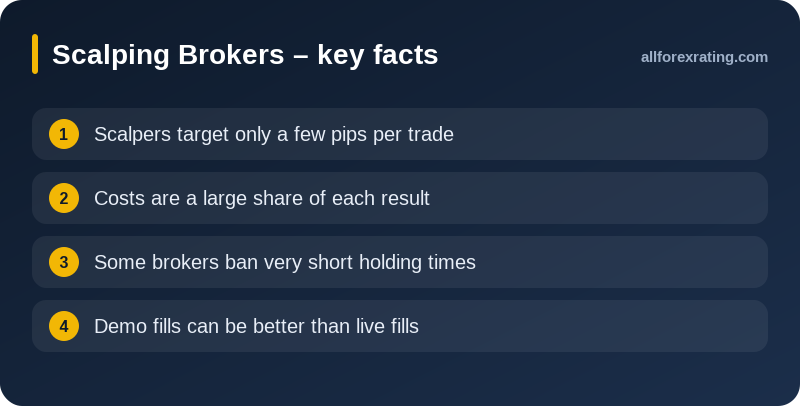
Scalping is a trading style that aims to capture very small price moves many times a day. A typical scalper might take dozens of trades in a session, holding each one briefly and closing it as soon as a small target or stop is hit. Strategies range from manual order-flow reading on one-minute charts to fully automated systems. You can explore approaches in our forex strategies section.
With targets this small, costs and execution quality form a large share of each result. A one-pip difference in spread can turn a modestly profitable approach into a losing one.
Consider a simple example. If your average target is five pips and your all-in cost is one pip, the cost consumes a fifth of every winning trade before slippage is counted. Halve that cost and your break-even win rate drops noticeably. This arithmetic is why experienced scalpers spend so much time comparing brokers, and why they track execution data rather than relying on advertised figures.
| Model | How orders are handled | Relevance for scalping |
|---|---|---|
| Market maker (dealing desk) | Broker takes the other side of trades | Can work well, but check rules on short holding times |
| STP | Orders passed to liquidity providers | Generally neutral to strategy; spreads may include a markup |
| ECN-style | Orders matched against multiple liquidity sources | Raw spreads plus commission, a common choice for scalpers |
Labels are used loosely in marketing, so rely on the broker's order execution policy document rather than the name of the account.
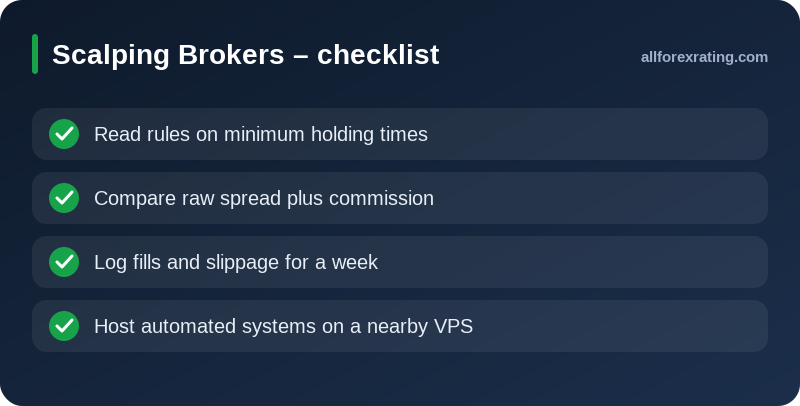
For automated systems, physical distance between your terminal and the trade server adds delay. Many traders host their platform on a VPS in the same data centre region as the broker, such as London or New York. If you run robots, our expert advisor guide explains setup basics.
Open a small live account rather than relying only on demo, since demo fills can be more generous. Log every trade for a week: requested price, filled price, spread at entry and time to fill. Compare results at quiet times and around releases you can track on our live forex market page. Data you collect yourself is more useful than any marketing claim.
Also note the session times your strategy relies on. Liquidity is usually deepest when the London and New York sessions overlap, while the Asian session and the hour around the daily rollover can see wider spreads. A broker that looks competitive at midday may be far less attractive at the times you actually trade.
The ranking above is driven by For and Against votes from traders, so brokers that frustrate short-term traders with slippage or restrictive rules tend to attract negative feedback. Use the list to narrow your options, then confirm regulation on the regulator's register, such as the database of the US National Futures Association for American clients or the relevant authority in your country.
Risk note: scalping involves high trade frequency and usually leverage, which multiplies both costs and potential losses. Many traders who attempt it lose money, so test carefully and keep each trade's risk small.
No. Some brokers restrict very short trades or reserve the right to cancel profits from them. Check the client agreement and order execution policy before trading.
Many scalpers prefer raw-spread or ECN-style accounts with a commission, because the total cost per trade is often lower than on a standard spread-only account.
Most scalpers work on tick, one-minute or five-minute charts, often using a higher timeframe to identify the main trend before entering.
It is one of the hardest styles to master because costs, speed and discipline all matter. Beginners usually benefit from practising slower strategies first.