, 10 min read
$50 No Deposit Forex Bonus 2027 Top 6 Best Brokers
$50 no deposit bonus is promotional trading credit a broker adds to a new live account after sign-up, usually after phone or ID checks. You...
Read article$50 no deposit bonus is promotional trading credit a broker adds to a new live account after sign-up, usually after phone or ID checks. You...
Read articleCompare forex broker ratings from leading independent review sites side by side. See the top-rated brokers for 2027 — IG, Pepperstone, FP Ma...
Read articleKCM Trade AI Mentor vs Human Analysts gives beginners a clear comparison of feedback, guidance, and learning speed before they choose a path...
Read articleSolus Finance brings trading contests to life with a gamified platform for competition, strategy, and real-time performance tracking.
Read articleCompare Forex brokers in 2027 with a wider lens, from spreads and commissions to regulation, trading tools, order quality, and client servic...
Read articleGFunded Prop Firm Review with a clear look at rules, funding options, fees, payouts, and support, plus who it fits and who should skip.
Read articleSee which of the 7 best regulated forex brokers for 2027 offer strong oversight, fair pricing, and secure tools for active day and swing tra...
Read articleCommon promotions include a matched welcome bonus, where the broker adds funds equal to your deposit. For instance, deposit $100, trade with...
Read articleSee the Best Copy Forex Trading Platforms for 2027, ranked by cost, tools, and safety. Compare signals, copy pros, and pick a broker you can...
Read articleFind forex brokers with 5 no-deposit bonuses in 2027, top picks only. We rate rules, withdrawal limits, and support, so you can try with no...
Read articleJoin RoboForex and claim your $30 welcome bonus. Experience quick access to global markets and open your first trades with zero deposit.
Read articleMaxifyFX offers a $35 sign-up no deposit Forex bonus for new users. Trade with bonus funds and discover platform features without risking yo...
Read articleJustMarkets now offers new app users a $10 free promotion, making it easy to start trading without any deposit. After signing up, you'll get...
Read articleLearn how forex deposit bonuses can give your trading account a real edge. Simple tips help you use every bonus to its fullest potential.
Read articleGrab a $50 FenzoFx No Deposit Bonus today. Sign up in minutes and test the platform risk-free. Get started with extra funds on your account.
Read articleGet honest insights into KCM Trade broker's features, fees, and reliability. Understand if it’s the right platform for your investment goals...
Read articleStart trading with Grand Capital $500 No Deposit Bonus. Trade without risk and explore real market opportunities. Sign up and claim your bon...
Read articleVonway is offering an 85% Forex trading bonus for Eid Al-Fitr, available for a limited time. This promotion is designed to enhance your trad...
Read articleClaim your free $30 no deposit bonus from Vonway Forex today. Start trading risk-free and unlock new opportunities in the forex market!
Read articleStarting with a $50 bonus on an XM trading account can be a great way to test the waters of forex trading without risking your own money.
Read articleGood forex education turns a confusing, fast-moving market into a set of skills you can learn one at a time. The lessons listed above cover everything from how exchange rates are formed to managing a live account, and this guide shows how to organise them into a study plan that fits your experience.
Social media is full of trade ideas, but isolated tips rarely explain the reasoning behind them. A structured course of reading builds the foundations first, so later topics such as technical patterns or interest rate analysis make sense. It also helps you recognise unrealistic claims, which is valuable protection in a market that attracts aggressive marketing.
Structure also saves time. Instead of rereading the same introductory material in a dozen places, you progress through topics in a logical order and can see exactly which areas still need work. Many traders find it helpful to note each finished lesson and one practical takeaway, which turns passive reading into an active checklist.
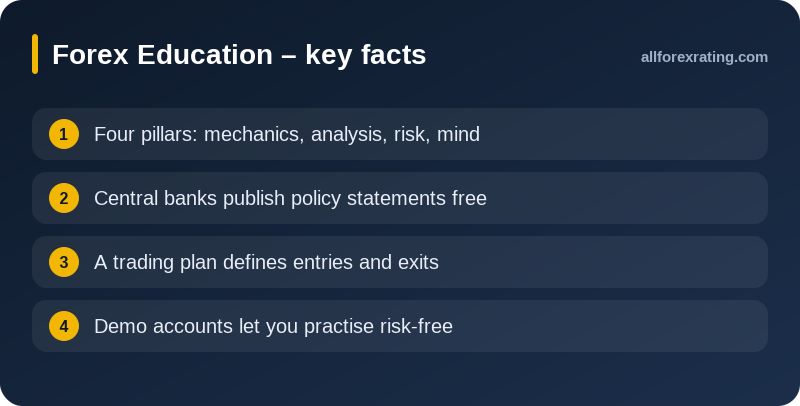
Almost every article in this category belongs to one of four areas. A balanced trader develops all of them.
| Pillar | Main topics | Related section |
|---|---|---|
| Market mechanics | Pairs, pips, lots, leverage, margin, sessions | Beginner guides |
| Analysis | Charts, indicators, economic data, central bank policy | Technical analysis |
| Risk management | Position sizing, stop-loss placement, drawdown limits | Lessons above |
| Psychology | Discipline, journaling, handling losing streaks | Lessons above |
Learn how quotes work, what moves currencies and how leverage and margin affect your account. Install a trading platform and open a demo account. Our trading platforms overview explains the main options, including MetaTrader 4 and 5.
Study candlestick charts, support and resistance, trend lines and one or two indicators. In parallel, follow the economic calendar and read how interest rate decisions influence currencies. Official sources such as the European Central Bank publish policy statements that are worth reading in full rather than through headlines.
Write a simple trading plan: which pairs, which timeframe, entry and exit rules, and a fixed percentage of the account risked per trade. Practise calculating lot sizes until it becomes automatic.
Trade the plan on demo, record every trade in a journal and review results weekly. Look for rule breaks before you look for new strategies.
At the end of the twelve weeks, compare your journal with your plan. Which rules did you follow, which did you skip, and what happened when you did? Honest answers here are more valuable than any single indicator.
People learn in different ways. Some prefer reading detailed articles like those above, others learn faster by watching a platform in action or by discussing trades with peers. Whatever your style, combine at least two approaches: read the theory, then apply it on a chart. Short daily sessions of thirty minutes often beat occasional long weekends of study, because the market itself becomes your practice ground.
Once the foundations are in place, ongoing forex education keeps your skills current. Regulations change, new platform features appear and market regimes shift between trending and ranging phases, so plan to revisit key lessons regularly rather than treating learning as finished.
Education only pays off when it is applied carefully. When you feel ready to move from demo to live, choose a regulated broker with transparent costs. The trader-voted full broker list and our guide on how to open a forex account walk you through the practical steps.
Remember that forex education reduces avoidable mistakes but cannot remove market risk. Trading leveraged CFDs carries a high risk of rapid losses, so keep learning, start small and protect your capital first.
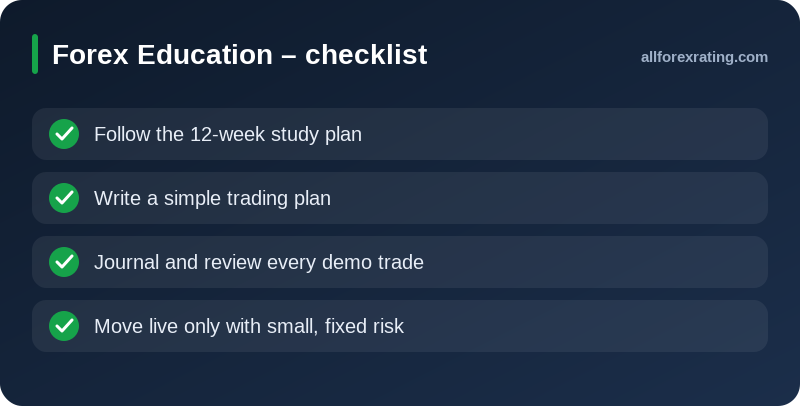
Follow a structured path: learn market mechanics, then analysis, then risk management, and practise each step on a demo account. Keeping a trading journal speeds up learning considerably.
Most people can grasp the basics within a few weeks of regular study. Becoming consistent usually takes many months of practice and honest review, and there is no fixed timeline.
Many free resources cover the essentials well, especially when they explain risk clearly. Be cautious with paid courses that promise guaranteed returns or fast riches.
Many traders start with basic chart reading because it is visual and quick to practise. Understanding key fundamentals, such as interest rates and inflation data, is still important for context.