, 10 min read
$50 No Deposit Forex Bonus 2027 Top 6 Best Brokers
$50 no deposit bonus is promotional trading credit a broker adds to a new live account after sign-up, usually after phone or ID checks. You...
Read article$50 no deposit bonus is promotional trading credit a broker adds to a new live account after sign-up, usually after phone or ID checks. You...
Read articleCompare forex broker ratings from leading independent review sites side by side. See the top-rated brokers for 2027 — IG, Pepperstone, FP Ma...
Read articleKCM Trade AI Mentor vs Human Analysts gives beginners a clear comparison of feedback, guidance, and learning speed before they choose a path...
Read articleSolus Finance brings trading contests to life with a gamified platform for competition, strategy, and real-time performance tracking.
Read articleCompare Forex brokers in 2027 with a wider lens, from spreads and commissions to regulation, trading tools, order quality, and client servic...
Read articleGFunded Prop Firm Review with a clear look at rules, funding options, fees, payouts, and support, plus who it fits and who should skip.
Read articleSee which of the 7 best regulated forex brokers for 2027 offer strong oversight, fair pricing, and secure tools for active day and swing tra...
Read articleCommon promotions include a matched welcome bonus, where the broker adds funds equal to your deposit. For instance, deposit $100, trade with...
Read articleSee the Best Copy Forex Trading Platforms for 2027, ranked by cost, tools, and safety. Compare signals, copy pros, and pick a broker you can...
Read articleFind forex brokers with 5 no-deposit bonuses in 2027, top picks only. We rate rules, withdrawal limits, and support, so you can try with no...
Read articleJoin RoboForex and claim your $30 welcome bonus. Experience quick access to global markets and open your first trades with zero deposit.
Read articleMaxifyFX offers a $35 sign-up no deposit Forex bonus for new users. Trade with bonus funds and discover platform features without risking yo...
Read articleJustMarkets now offers new app users a $10 free promotion, making it easy to start trading without any deposit. After signing up, you'll get...
Read articleLearn how forex deposit bonuses can give your trading account a real edge. Simple tips help you use every bonus to its fullest potential.
Read articleGrab a $50 FenzoFx No Deposit Bonus today. Sign up in minutes and test the platform risk-free. Get started with extra funds on your account.
Read articleGet honest insights into KCM Trade broker's features, fees, and reliability. Understand if it’s the right platform for your investment goals...
Read articleStart trading with Grand Capital $500 No Deposit Bonus. Trade without risk and explore real market opportunities. Sign up and claim your bon...
Read articleVonway is offering an 85% Forex trading bonus for Eid Al-Fitr, available for a limited time. This promotion is designed to enhance your trad...
Read articleClaim your free $30 no deposit bonus from Vonway Forex today. Start trading risk-free and unlock new opportunities in the forex market!
Read articleStarting with a $50 bonus on an XM trading account can be a great way to test the waters of forex trading without risking your own money.
Read articleThe forex for masters category is written for traders who already know what a pip is and have survived a few market cycles. The posts listed above go beyond definitions and focus on the details that separate a consistent professional approach from casual trading: risk architecture, execution, data and self-review.
If you trade live, keep a journal, and can explain why your last ten trades were taken, you are the intended reader. If terms such as margin call or stop-loss still feel new, start with our beginner articles first and return here later. Advanced material is most useful when it can be tested against your own track record.
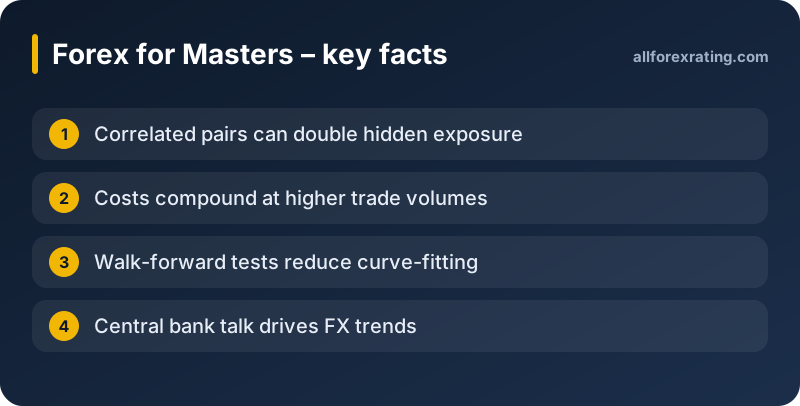
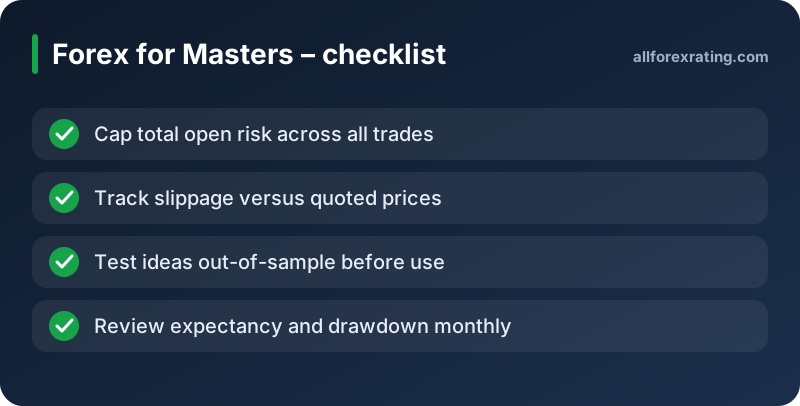
Experienced traders measure exposure across all open positions. Long EUR/USD and long GBP/USD are largely the same bet against the US dollar, so correlation, total open risk and maximum drawdown matter more than the stop on any single ticket. Several posts explain fixed-fractional sizing, volatility-adjusted position size and how to set a daily loss limit that you actually respect.
Understanding where liquidity sits - session opens, round numbers, prior highs and lows, option expiries - helps explain sudden spikes and stop runs. We also cover how central bank communication from bodies such as the Federal Reserve shifts rate expectations and, with them, currency trends.
At higher volumes, small costs compound. Spread, commission, slippage and swap can turn a positive system negative. Advanced traders track their average fill versus the quoted price and compare accounts. Our low spread brokers list and the trader votes on each broker are a practical way to shortlist venues with competitive pricing.
Many seasoned traders automate parts of their process, from alerts to full robots. Posts here discuss walk-forward testing, out-of-sample data, curve-fitting warning signs and running strategies on a VPS. If you build or buy robots, see our expert advisor section for related tools.
Use this monthly routine alongside the articles to turn reading into measurable improvement:
| Metric | Question to ask | Typical fix |
|---|---|---|
| Expectancy | Is my average win times win rate larger than my average loss times loss rate? | Cut low-quality setups |
| Maximum drawdown | Could I live with this drop psychologically and financially? | Reduce risk per trade |
| Cost per trade | What share of gross profit goes to spread, commission and swap? | Change account type or broker |
| Rule breaks | How many trades ignored my written plan? | Tighten checklists and limits |
After the technical basics are mastered, the biggest remaining edge is often behavioural. Experienced traders still face overconfidence after a winning streak, revenge trading after a loss and the temptation to override a tested system. Posts on this theme cover pre-trade routines, written rule sets and the value of stepping away from the screen when your daily limit is hit.
Experience does not remove risk. Leveraged forex and CFD trading can produce losses that exceed expectations, especially around gaps, illiquid holiday sessions and surprise policy decisions. The forex for masters posts share methods and frameworks, not guaranteed returns, so size every position as if the next trade could be a loser.
Treat each article in forex for masters as a hypothesis to test against your own data. What works for one trader on one timeframe may fail for another, and only your journal can show which ideas genuinely improve your results.
If you want to see how other experienced traders rate the brokers they use, browse the latest trader reviews and comments; first-hand reports on fills, withdrawals and support often reveal more than a marketing page.
Advanced traders manage risk across the whole portfolio, measure their costs and results precisely, and follow a tested written plan. Beginners tend to focus on entries while ignoring sizing and review.
They limit risk per trade and per day, reduce position size during losing streaks and pause trading when a predefined drawdown level is reached. The aim is to survive long enough for an edge to play out.
Neither is automatically better. Automation removes some emotional errors and allows systematic testing, but robots can fail when market conditions change, so they still need monitoring.
Positions in closely correlated pairs tend to win or lose together. Without accounting for correlation, a trader may carry far more exposure to one currency than intended.