Submit a Forex Broker
Know a broker that is missing from our ranking? Send us the details below. Every submission is checked against the regulator's register before it is published – listing is free.
Broker details
Open Forex Account Guide: From Sign-Up to First Trade
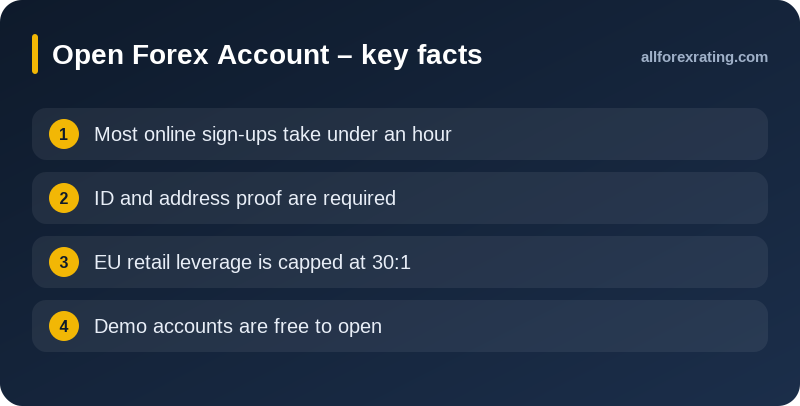
This open forex account guide walks you through every stage, from choosing a regulated broker to placing your first small trade. Most sign-ups take less than an hour online, but the decisions you make before you click "register" matter far more than the form itself.
Before You Start
Ask yourself why you want to trade, how much money you can afford to lose and how much time you can give it each week. Currency trading with leverage can wipe out a deposit quickly, so it suits only money you would not need for bills, savings or emergencies. If you are new to markets, spend time with our forex for beginners articles first.
7 Steps to Open a Trading Account
- Choose a regulated broker. Shortlist firms from the full broker directory, where rankings come from trader votes, and confirm each licence on the regulator's own register.
- Compare conditions. Put your finalists into the comparison tool to check spreads, platforms, minimum deposit and funding options.
- Practise on a demo. A free demo account lets you learn the platform and test your plan without risking real money.
- Register online. Enter your name, email, phone, country and a strong password. Use your legal name exactly as it appears on your ID.
- Complete the questionnaire. Regulated brokers must ask about your experience, income and understanding of leverage. Answer honestly; it determines what products and leverage you can access.
- Verify your identity. Upload the documents listed below. Approval can take minutes or a few business days.
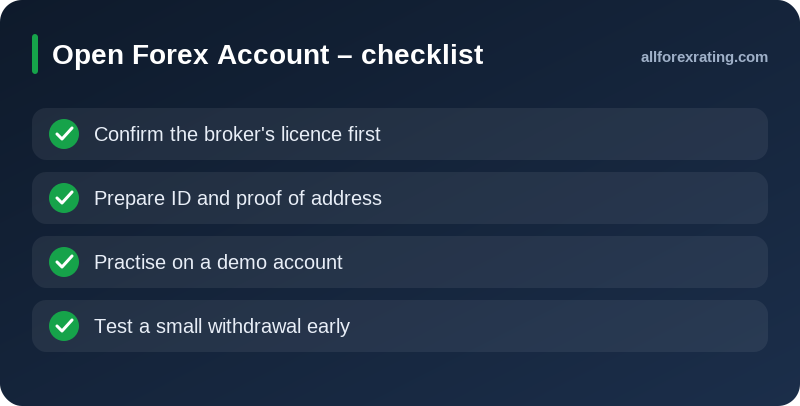
- Fund and start small. Deposit a modest amount, place a small trade, and request a test withdrawal early to confirm the process works.
Open Forex Account Documents Checklist
| Document | Accepted examples | Tips |
|---|---|---|
| Proof of identity | Passport, national ID card, driving licence | Valid, colour, all four corners visible |
| Proof of address | Utility bill, bank statement, tax letter | Usually issued within the last 3 to 6 months |
| Payment proof | Card photo with middle digits hidden, e-wallet screenshot | Requested by some brokers before withdrawals |
These checks follow anti-money-laundering rules and protect you as well as the broker. Be cautious of any firm that skips verification entirely.
Choosing the Right Account Type
Standard vs raw spread accounts
Standard accounts usually include the broker's fee in the spread, which keeps costs simple. Raw or ECN-style accounts offer tighter spreads plus a fixed commission, which often suits active traders. Compare the total cost on the pairs you plan to trade.
Base currency and funding method
Choosing a base currency that matches your bank account can avoid conversion fees. If you prefer e-wallets, see our list of PayPal brokers. Withdrawals are normally sent back to the original deposit method first.
Understanding Leverage and Protection
Leverage lets you control a large position with a small deposit, which magnifies both profit and loss. In the EU, rules coordinated by the European Securities and Markets Authority cap retail leverage on major currency pairs at 30:1 and require negative balance protection. Other regions have their own limits. Start with low effective leverage and always use a stop-loss.
After Approval: Your First Week
Once the broker approves your documents, resist the urge to trade immediately with your full plan. Use the first week to set up the platform properly and confirm that everything behaves as expected:
- Enable two-factor authentication and save the broker's support contacts.
- Set default lot sizes small so a mis-click cannot open a large position.
- Place one or two minimum-size trades with stop-loss orders attached.
- Check how swaps, commissions and spreads appear in your account history.
Common Sign-Up Mistakes
- Choosing a broker because of a large bonus rather than regulation and costs.
- Exaggerating experience in the questionnaire to unlock higher leverage.
- Depositing your full trading budget before testing a withdrawal.
- Letting an unsolicited "account manager" place trades for you.
When you follow these steps, you can open forex account access with confidence and begin with a clear, cautious plan. Keep records of every deposit and withdrawal, and review your results monthly before adding more funds.
Open Forex Account – FAQ
How much money do I need to open a forex account?
Minimum deposits vary by broker, from very small amounts to several hundred dollars. Start with an amount you can afford to lose entirely.
How long does account verification take?
Many brokers verify documents within minutes using automated checks, but manual reviews can take one to three business days.
Can I open a trading account without ID?
Regulated brokers must verify your identity under anti-money-laundering rules. A broker that asks for no ID is a serious warning sign.
Can I have both a demo and a live account?
Yes. Most brokers let you keep a demo account alongside your live account, which is useful for testing new strategies.