
Upbit trading volume – last 30 days
The volume chart appears after the next data update.
Live data from CoinGecko, updated 47 minutes ago.
Upbit is built for one market. It is the largest exchange in South Korea by volume, and almost everything about it, from its fee table to its fiat rails, is designed around the Korean won. This Upbit review is mainly useful if you live in Korea or want to understand the country's biggest trading venue.
Who runs it
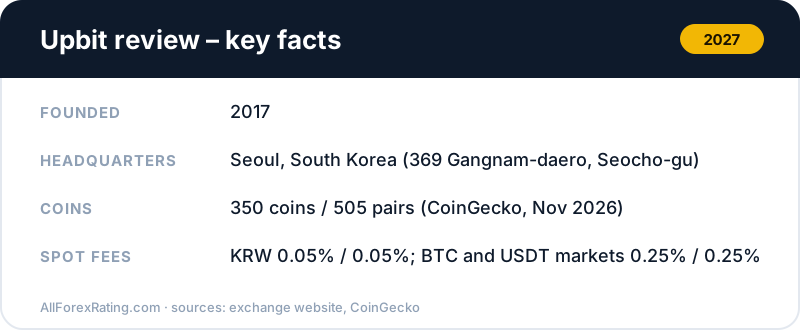
Upbit is operated by Dunamu and is registered as an exchange in South Korea. Its headquarters is in Seocho-gu, Seoul. It launched in 2017.
CoinGecko also lists a Singapore Major Payment Institution licence for Upbit. That entry is AI-sourced on CoinGecko and we could not confirm it, so treat it as unverified.
Three markets, two price levels
Upbit splits trading into three markets, and the fees differ sharply between them:
- KRW market: 0.05% maker and 0.05% taker on limit orders
- BTC market: 0.25% maker and 0.25% taker
- USDT market: 0.25% maker and 0.25% taker
The won market is the cheap one, and it is also where most of the volume sits. Trading against BTC or USDT costs five times as much. If you can fund in won, the KRW market is the obvious choice.
A quick example
Suppose you buy coins worth KRW 1,000,000 with a limit order. In the KRW market the fee is KRW 500. The same trade in the BTC or USDT market, at 0.25%, costs the equivalent of KRW 2,500. Over dozens of trades, that gap adds up.
Upbit review of coins and products
CoinGecko lists 350 coins and 505 pairs as of November 2026. That is a solid range for a domestic exchange.
The product set is deliberately narrow. You get spot trading in the three markets above, plus staking. There is no futures desk, no margin and no copy trading. For investors who simply want to buy and hold, that simplicity can be a plus. Active traders who rely on leverage will need another venue.
Liquidity in won
The main draw is deep KRW liquidity. A Korean resident can deposit won and trade popular coins in a busy order book without first converting to stablecoins.
Security history
Upbit has been hit twice, both times through hot wallets.
In November 2019 about 342,000 ETH, worth roughly $49 million at the time, was stolen. Korean police later attributed the theft to North Korea, according to The Block.
On 27 November 2025 a breach on the Solana network drained a hot wallet of about KRW 44.5 billion. Reports put the dollar value between about $30 million and $37 million. Upbit said it covered the full loss.
Oddly, CoinGecko's profile still shows no incidents recorded. Do not rely on that field alone when you assess the exchange.
Opening an account
Upbit's services are aimed at Korean residents. Expect to verify your identity and link a Korean bank account to deposit won. Foreign users will find the platform of limited use. Once funded, a limit order in the KRW market keeps you on the lowest fee rate.
Is Upbit worth it?
For someone living in South Korea, Upbit is hard to ignore. The KRW market is cheap and liquid, and the operator is a regulated domestic company. Staking is a small extra for holders who want rewards on coins they already own.
The trade-offs are clear. There are no derivatives, the cross-currency markets are expensive and two hot-wallet hacks sit on the record. Anyone outside Korea will be better served by an international exchange.
How Upbit compares
Before you sign up, compare Upbit with the other exchanges in our top 20 crypto exchanges ranking, where trust score and 24-hour volume update live. Two useful comparisons are the Bybit review and the Kraken review. You can also follow prices on our live crypto charts. Fees, licences and coin lists change often, so check the current terms on the official site at upbit.com before you deposit.
Pros
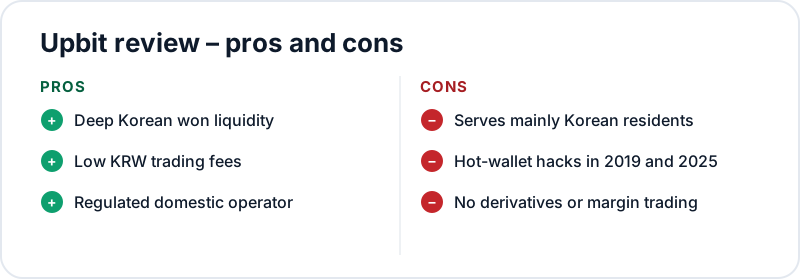
- Deep Korean won liquidity
- Low KRW trading fees
- Regulated domestic operator
Cons
- Serves mainly Korean residents
- Hot-wallet hacks in 2019 and 2025
- No derivatives or margin trading
Crypto market indicators today
Bitcoin price with SMA 20 / SMA 50 (60 days)
RSI 14 (Relative Strength Index)
Crypto Fear & Greed Index
Last 30 days. 0–24 extreme fear, 25–44 fear, 45–55 neutral, 56–75 greed, 76–100 extreme greed. Source: alternative.me
Indicators are calculated from CoinGecko daily closing prices. They describe the market and are not trading advice.
Upbit – frequently asked questions
What are Upbit's trading fees?
The KRW market charges 0.05% maker and taker on limit orders, while the BTC and USDT markets charge 0.25% each.
Can foreigners use Upbit?
Upbit mainly serves Korean residents, and its main market is built around Korean won deposits.
Has Upbit been hacked?
Yes. About 342,000 ETH was stolen in November 2019, and a Solana hot-wallet breach of about KRW 44.5B hit on 27 November 2025; Upbit said it covered that loss.
Does Upbit offer futures trading?
No. Upbit offers spot trading in KRW, BTC and USDT markets plus staking, with no derivatives or margin.