, 10 min read
$50 No Deposit Forex Bonus 2027 Top 6 Best Brokers
$50 no deposit bonus is promotional trading credit a broker adds to a new live account after sign-up, usually after phone or ID checks. You...
Read article$50 no deposit bonus is promotional trading credit a broker adds to a new live account after sign-up, usually after phone or ID checks. You...
Read articleCompare forex broker ratings from leading independent review sites side by side. See the top-rated brokers for 2027 — IG, Pepperstone, FP Ma...
Read articleKCM Trade AI Mentor vs Human Analysts gives beginners a clear comparison of feedback, guidance, and learning speed before they choose a path...
Read articleSolus Finance brings trading contests to life with a gamified platform for competition, strategy, and real-time performance tracking.
Read articleCompare Forex brokers in 2027 with a wider lens, from spreads and commissions to regulation, trading tools, order quality, and client servic...
Read articleGFunded Prop Firm Review with a clear look at rules, funding options, fees, payouts, and support, plus who it fits and who should skip.
Read articleSee which of the 7 best regulated forex brokers for 2027 offer strong oversight, fair pricing, and secure tools for active day and swing tra...
Read articleCommon promotions include a matched welcome bonus, where the broker adds funds equal to your deposit. For instance, deposit $100, trade with...
Read articleSee the Best Copy Forex Trading Platforms for 2027, ranked by cost, tools, and safety. Compare signals, copy pros, and pick a broker you can...
Read articleFind forex brokers with 5 no-deposit bonuses in 2027, top picks only. We rate rules, withdrawal limits, and support, so you can try with no...
Read articleJoin RoboForex and claim your $30 welcome bonus. Experience quick access to global markets and open your first trades with zero deposit.
Read articleMaxifyFX offers a $35 sign-up no deposit Forex bonus for new users. Trade with bonus funds and discover platform features without risking yo...
Read articleJustMarkets now offers new app users a $10 free promotion, making it easy to start trading without any deposit. After signing up, you'll get...
Read articleLearn how forex deposit bonuses can give your trading account a real edge. Simple tips help you use every bonus to its fullest potential.
Read articleGrab a $50 FenzoFx No Deposit Bonus today. Sign up in minutes and test the platform risk-free. Get started with extra funds on your account.
Read articleGet honest insights into KCM Trade broker's features, fees, and reliability. Understand if it’s the right platform for your investment goals...
Read articleStart trading with Grand Capital $500 No Deposit Bonus. Trade without risk and explore real market opportunities. Sign up and claim your bon...
Read articleVonway is offering an 85% Forex trading bonus for Eid Al-Fitr, available for a limited time. This promotion is designed to enhance your trad...
Read articleClaim your free $30 no deposit bonus from Vonway Forex today. Start trading risk-free and unlock new opportunities in the forex market!
Read articleStarting with a $50 bonus on an XM trading account can be a great way to test the waters of forex trading without risking your own money.
Read articleThe forex signals published in this category are trade ideas that suggest a currency pair, a direction and key price levels. The posts listed above are meant to support your own analysis, not replace it, and this guide explains how to read a signal, judge its quality and decide whether it fits your plan.
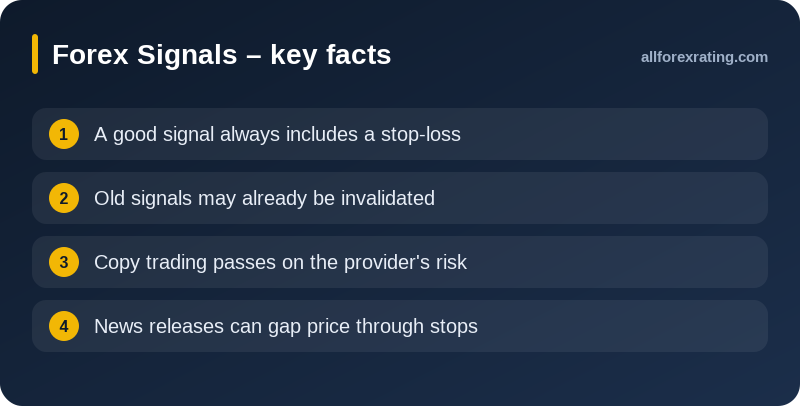
A well-formed signal contains enough information to act on and to manage risk. If any of these parts is missing, treat the idea with extra caution.
| Element | Example | Purpose |
|---|---|---|
| Pair and direction | Buy EUR/USD | What to trade and which way |
| Entry zone | A specific price or range | Where the idea is valid |
| Stop-loss | A level below support | Where the idea is proven wrong |
| Take-profit | One or more targets | Where to lock in gains |
| Rationale | Trend, level or news context | Why the trade makes sense |
| Time frame | Intraday or multi-day | How long the idea should last |
It is also fine to skip a signal. If the entry has passed, the reward-to-risk ratio no longer makes sense or the idea conflicts with a position you already hold, waiting for the next opportunity is a sound decision rather than a missed chance.
Written signals like the ones in this category explain the reasoning, which helps you learn. You keep full control over whether and how to trade. Reading the rationale also lets you check whether the logic still holds when you see the chart, and builds your own analytical skills over time.
Some platforms copy another trader's positions into your account automatically. It is convenient, but you inherit their risk, and past performance can change quickly.
Platforms such as MetaTrader 4 can send alerts when conditions are met, and expert advisors can act on them. See our expert advisor section if you want to explore automation.
Regulators repeatedly warn about investment schemes built on these tactics; the investor education pages at Investor.gov are a useful reference.
A few weeks of results say little; dozens of trades say much more. When you review forex signals you have followed, look at the win rate together with the average win and average loss, the largest drawdown and how closely your fills matched the published levels. A source with a modest win rate can still be useful if its winners are clearly larger than its losers, while a high win rate with occasional huge losses is a warning sign.
Signals work best as one input among several. Pair them with the market context in our forex analysis posts and the daily market overviews, and execute them with a broker whose costs suit frequent trading. The trader-voted low spread brokers page can help with that choice.
Trading forex signals with leverage still carries a high risk of loss. No idea published here is personal advice or a promise of profit, so decide position size yourself and never risk money you cannot afford to lose.
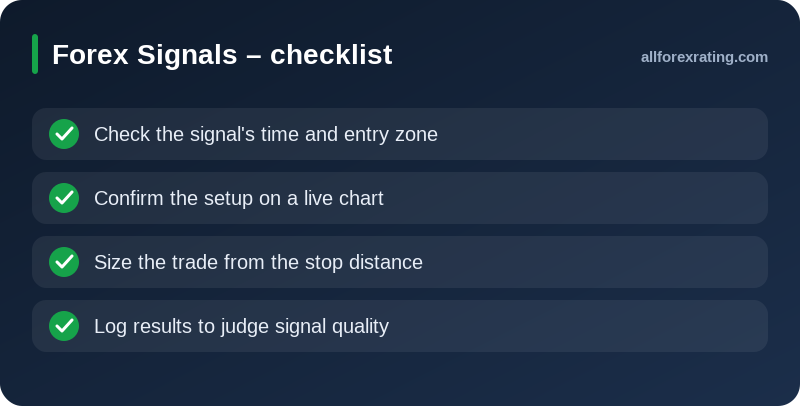
They can save analysis time and teach new perspectives, but quality varies widely. Track every followed idea so you can judge whether a source genuinely helps your results.
Price alone says little about quality. Look for clear entry, stop and target levels, a verifiable track record and honest discussion of losses, whether a service is free or paid.
Warning signs include guaranteed profits, missing stop-losses, unverifiable screenshots and pressure to use a particular broker. Genuine providers are open about losing trades.
Not necessarily. Skip ideas that clash with your own plan, upcoming news or existing exposure, and always size trades according to your own risk limits.