
RoboForex
Min: Deposit $5, Leverage up to 1:2000 Broker STP/ECN $30 Free Bonus
Min: Deposit $5, Leverage up to 1:2000 Broker STP/ECN $30 Free Bonus

100% Forex Bonus, Min: Deposit $100, Broker Type: STP/NDD $30 Free Bonus

120% Forex Bonus, Min: Deposit $100 , Broker Type: STP/NDD $30 Free Bonus

Min: Deposit $1, Leverage up to 1:500, Type ECN/STP $30 No Deposit Bonus
| # | Logo | Broker | Year | For | Against | Type | Regulation | Leverage | Min. deposit | Review |
|---|---|---|---|---|---|---|---|---|---|---|
| 1 | JustMarkets | 2012 | 36% | 4% | ECN/STP | FSA, CySEC, FSCA, FSC | 1:3000* | 1 | Review | |
| 2 | Headway | 2023 | 35% | 4% | CFDs | Regulated by FSCA | 1:1000* | 100 | Review | |
| 3 | Valetax | 2023 | 35% | 1% | ECN/STD | FSC | 1:2000* | 10 | Review | |
| 4 | RoboForex | 2009 | 35% | 4% | ECN/STD | FSC | 1:2000* | 10 | Review | |
| 5 | XM | 2009 | 35% | 1% | Broker, MM | ASIC, CySEC, IFSC | 1:888* | 10 | Review | |
| 6 | KCM Trade | 2016 | 32% | 3% | ECN/STD | FSC | 1:400* | 100 | Review | |
| 7 | Plotio | 1983 | 31% | 2% | STP | HKGX, ASIC, SCB | 1:300* | 200 | Review | |
| 8 | FISG | 2011 | 30% | 1% | ECN/STD | FSA, CySEC, ASIC | 1:500 | 0.01 | Review | |
| 9 | Amillex | 2025 | 29% | 6% | ECN/STP | ASIC, FCA | Up to 1:500 | 100 | Review | |
| 10 | ATFX | 2017 | 25% | 3% | Broker/NDD | FCA, CySEC, FSCA | 1:400* | 100 | Review | |
| 11 | Octa | 2011 | 20% | 3% | ECN/STD | Regulation: CySEC, MISA, FSCA and FSC | 1:1000* | 5 | Review | |
| 12 | Trust Capital | 2019 | 20% | 2% | CFDs | FSA, CySEC, SCA | Up to 1:1000 | 100 | Review | |
| 13 | Axiory | 2011 | 15% | 5% | Broker, NDD | IFSC, FSC, FCA (UK) | 1:777* | 10 | Review | |
| 14 | FBS | 2009 | 13% | 4% | ECN/STD | IFSC, CySEC, ASIC, FSCA | 1:3000* | 100 | Review | |
| 15 | Yamarkets | 2018 | 11% | 2% | ECN/STD | VFSC, MISA, | 1:1000* | 100 | Review | |
| 16 | Hantec | 1990 | 10% | 6% | ECN/STP | ASIC, FCA, FSA-Japan, FSC, JSC | 1:2000* | 100 | Review | |
| 17 | FXTRADING | 2014 | 9% | 3% | ECN/STD | AFSL, VFSC | 1:500* | 100 | Review | |
| 18 | FXTM | 2011 | 5% | 0% | ECN/STD/MM | FSC, FCA, CySEC, FSCA | 1:500 | 10 | Review | |
| 19 | ActivTrades | 2001 | 5% | 1% | ECN/STD | FCA, CSSF | 1:300* | 250 | Review | |
| 20 | Exness | 2008 | 5% | 0% | ECN, Market Maker, NDD | FCA, CySEC, SFSA, CNMV, AFM, BaFin | 1000 | 1 | Review | |
| 21 | FX Choice | 2009 | 5% | 30% | NDD, Market Execution | FSC | 1:200* | 100 | Review | |
| 22 | FxPro | 2006 | 4% | 0% | Broker, NDD | CySEC, FCA, FSCA, SCB | 1:200* | 10 | Review | |
| 23 | HFM | 2010 | 4% | 3% | ECN/STD | CySEC, FCA, DFSA, FSCA, FSA, CMA | 1:1000* | 5 | Review | |
| 24 | IronFX | 2010 | 4% | 3% | ECN/STD | FCA, ASIC, FSCA and CySEC | 1:500* | 10 | Review | |
| 25 | FXCM | 1999 | 4% | 0% | ECN/STD | FCA, ASIC, CONSOB, BaFin | 1:500* | 10 | Review | |
| 26 | NordFX | 2008 | 4% | 0% | ECN/STD | VFSC, CySEC, SEBI | 1:1000* | 10 | Review | |
| 27 | FP Markets | 2005 | 4% | 0% | ECN/STP/DMA | ASIC, CySEC | 1:1000* | 100 | Review | |
| 28 | AMarkets | 2007 | 4% | 0% | ECN/STD | SVGFSA (FSA) | 1:1000* | 10 | Review | |
| 29 | M4Markets | 2020 | 4% | 0% | ECN/STD | SVGFSA, Licence No SD035 | 1:500* | 50 | Review | |
| 30 | CWG Markets | 2018 | 4% | 0% | ECN/MM | FCA (UK) VFSC | 1:500* | 100 | Review | |
| 31 | LBLV | 2018 | 3% | 0% | ECN/STD | Seychelles FSA | 1:500* | 10 | Review | |
| 32 | FXCC | 2010 | 3% | 0% | ECN/STD/MM | CySEC | 1:200* | 10 | Review | |
| 33 | Libertex | 1997 | 3% | 0% | ECN/STD | CySEC | 1:3000* | 10 | Review | |
| 34 | Axiance | 2020 | 3% | 1% | ECN/STD | CySEC, FSA, FSC | 1:100* | 100 | Review | |
| 35 | FXPRIMUS | 2015 | 3% | 0% | ECN/STD | FSCA, VFSC, CySEC | 1:500* | 100 | Review | |
| 36 | TMGM | 2017 | 3% | 0% | ECN/STD | ASIC, FSP, VFSC | 1:400* | 200 | Review | |
| 37 | easyMarkets | 2001 | 3% | 0% | Broker | CySEC, MiFID, ASIC | 100 | 25 | Review | |
| 38 | Oanda | 1996 | 3% | 0% | Broker, MM | CFTC, NFA, FSA | 50 | 1 | Review | |
| 39 | eToro | 2007 | 3% | 0% | ECN/STD/MM | CySEC, ASIC, FCA | 400:1 | 50 | Review | |
| 40 | FxGlory | 2011 | 2% | 0% | ECN/STD/MM | IFSA | 1:3000* | 1 | Review | |
| 41 | Buxberg | 2021 | 2% | 0% | ECN/STD/MM | CFTC, NFA | 1:400* | 2500 | Review | |
| 42 | LegacyFX | 2012 | 2% | 0% | ECN/STD | VFSC, CySEC, NBRB, BaFin, FCA, FSP | 1:200* | 10 | Review | |
| 43 | AvaTrade | 2006 | 2% | 0% | ECN/STD | MiFiD, FSA, ASIC, FSRA, CySEC | 1:400* | 10 | Review | |
| 44 | LIRUNEX | 2016 | 2% | 0% | ECN/STD | CySEC | 1:1000* | 25 | Review | |
| 45 | FOREX.com | 1999 | 2% | 0% | Broker, MM | CFTC, FCA, ASIC, FSA | 50 | 500 | Review | |
| 46 | Saxo Bank | 1992 | 2% | 0% | ECN/STP/DMA | FSA | 200:1 | 2000 | Review | |
| 47 | Financial Centre | 2001 | 1% | 0% | Broker | FCA, UK | 1:3000 | 250 | Review | |
| 48 | Xpoken | 2020 | 1% | 0% | ECN/STD | No | 1:400* | 250 | Review | |
| 49 | CommerceWealth | 2020 | 1% | 0% | NDD | SVGFSA | 1:2000* | 5000 | Review | |
| 50 | Kiexo | 2020 | 1% | 2% | ECN/STD | N/A | 1:400* | 250 | Review |
Low spread brokers let you enter and exit positions with less of your money going to the bid/ask gap, which matters more the more often you trade. This guide explains how to judge low spread brokers properly, because the headline number on a homepage rarely tells the whole story about what a trade actually costs.
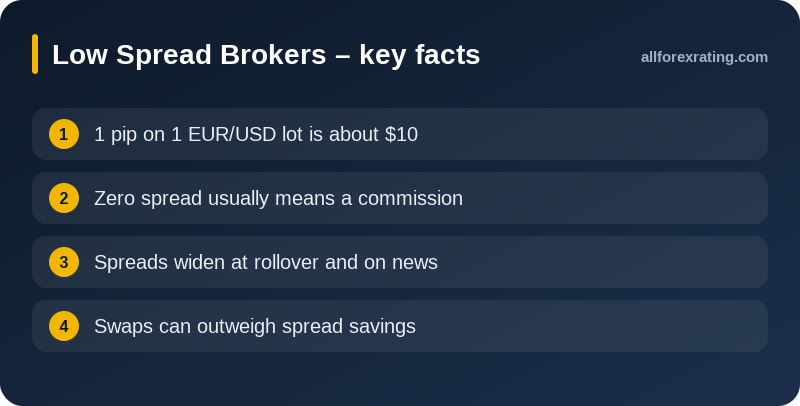
The spread is the difference between the price you can buy at (ask) and the price you can sell at (bid). You pay it on every round trip, win or lose. On a USD-quoted pair such as EUR/USD, one pip on a standard lot of 100,000 units is worth about $10, so a 1.2-pip spread costs roughly $12 per lot before anything else is added.
That figure is small on a single trade but compounds quickly. A trader opening ten lots a day pays the spread ten times, every day. Cutting the average spread by even a few tenths of a pip can make a noticeable difference to yearly costs, which is why active traders pay close attention to pricing.
Brokers price trades in different ways. Understanding the model is the first step toward a fair comparison.
| Model | How you pay | Typical trade-off |
|---|---|---|
| Fixed spread | Same spread in most conditions | Predictable, but usually wider on average |
| Variable spread | Spread moves with liquidity, no commission | Tight in calm markets, wider around news |
| Raw spread + commission | Near-interbank spread plus a fixed fee per lot | Often cheapest overall for frequent traders |
A "zero spread" account is not free. The cost is simply moved into a commission, so always add the two together.
Even the tightest pricing widens at certain times: the daily rollover around 5 pm New York time, thin holiday sessions, Sunday opens and major announcements such as central bank decisions or US payrolls. If your strategy depends on trading those moments, a low average spread offers limited protection. You can watch how quotes move in real time on our live forex markets page or on the EUR to USD chart.
A cheap quote is worthless if orders are filled poorly. Slippage, requotes and rejected orders all add hidden costs. Execution speed, the broker's order handling policy and the depth of its liquidity matter as much as the advertised number. This is especially true for short-term strategies covered on our scalping brokers page.
Regulation matters too. A broker licensed by a strong authority such as the UK Financial Conduct Authority must segregate client money and follow conduct rules, which protects you far more than a fraction of a pip ever could. Before opening an account, check the licence number on the regulator's own register.
The list above is ordered by real traders' For and Against votes rather than paid placement, so it reflects how people who actually use each broker feel about its pricing and service. Use it as a shortlist, then put two or three candidates side by side with our broker comparison tool to check account types, commissions and minimum deposits. Reading recent trader reviews can also reveal whether spreads stay competitive in fast markets.
Risk reminder: forex and CFDs are leveraged products. Lower trading costs improve your odds only slightly; they do not remove the risk of losing more than you expect. Trade sizes should always fit your account and your risk tolerance.
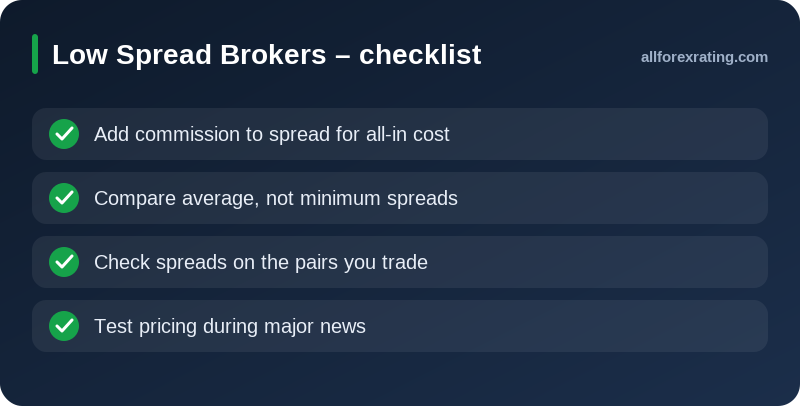
On major pairs like EUR/USD, an all-in cost below about 1 pip (spread plus commission) is generally competitive. Crosses, exotics and metals naturally carry wider spreads.
For frequent traders it often is, because the near-interbank spread plus a fixed commission tends to beat a commission-free account with a marked-up spread. Always compare the total cost per lot.
Variable spreads follow market liquidity. They are usually tightest when London and New York overlap and widen at rollover, on Sunday opens and around major economic releases.
No. Pricing says nothing about safety of funds. Check the broker's regulator, client money segregation and real user feedback before depositing.