BTC / USD Forex Rates Table Today, 12 11 2026
The .table class adds basic styling (light padding and only horizontal dividers) to a table:
| ASSET | LAST | LAST VOLUME,TO | CHANGE, 24h | OPEN | HIGH | LOW |
|---|---|---|---|---|---|---|
| BTC/USD | 23429.4 | 1,326.375 |
-3,912.700
|
27342.1 | 27482.7 | 22567.9 |
Currency Converter
Converted Amount :
BTC to USD: How the Bitcoin Price Works and What Moves It
The BTC to USD price shows how many US dollars one bitcoin is worth at a given moment. Unlike traditional currency pairs, bitcoin trades around the clock on hundreds of venues, so understanding where the quote comes from and what moves it is essential before you rely on the converter and live chart above.
Where the Price Comes From
There is no single official bitcoin rate. Each exchange has its own order book, and prices across venues usually sit close together because arbitrage traders quickly close large gaps. The figure on this page is a reference price aggregated from market data, which is why it may differ slightly from what you see on a particular exchange or broker.
Data aggregators such as CoinGecko publish volume-weighted averages, and many CFD brokers build their own quotes from several exchange feeds before adding a spread.
Reading the BTC to USD Converter
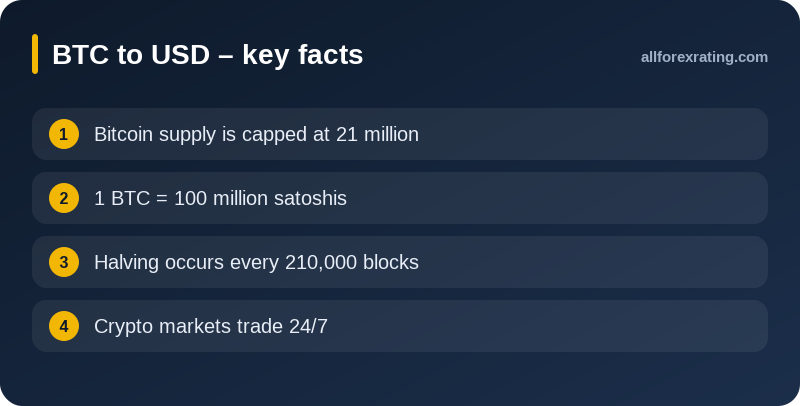
- Fractions are normal. One bitcoin divides into 100 million satoshis, so you can convert tiny amounts such as 0.001 BTC.
- Direction matters. Enter dollars to see how much bitcoin they buy, or enter BTC to see its dollar value.
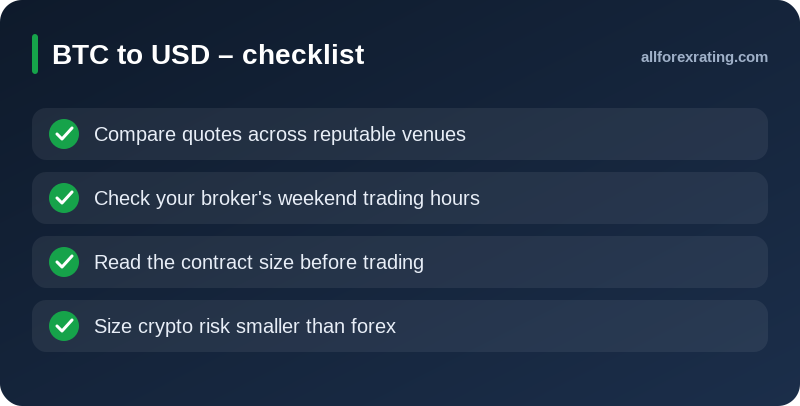
- Check the time. Crypto moves at weekends and overnight, so a quote from an hour ago may already be stale.
- Fees are extra. Exchanges charge trading fees and spreads, and withdrawals may carry network fees.
Key Drivers of the Bitcoin Price
Bitcoin has no central bank and no cash flows, so its value is driven by supply, demand and sentiment. These are the factors traders watch most closely.
Fixed Supply and the Halving
The protocol caps total supply at 21 million coins. Roughly every four years (every 210,000 blocks) the reward paid to miners is cut in half, slowing the rate at which new coins enter circulation. Many market participants follow this cycle, although past patterns are no guarantee of future moves.
Macro Conditions and the Dollar
Bitcoin often trades like a high-risk asset. Federal Reserve policy, real interest rates, US inflation data and overall liquidity can all shift appetite for crypto. A stronger dollar and tighter financial conditions have frequently coincided with weaker crypto markets.
Institutional Flows and Regulation
Spot exchange-traded products, corporate treasury buying, and regulatory decisions in major markets can shift demand quickly. Exchange failures, hacks and enforcement actions have historically caused sharp sell-offs.
Leverage in the Market
Crypto derivatives markets carry heavy leverage. When prices move fast, forced liquidations can cascade and exaggerate the move in either direction.
Trading Hours: Always On, but Not Always Liquid
The underlying market never closes, yet liquidity still follows a rhythm. Volume tends to be strongest when European and US trading hours overlap and when US stock markets are open. Weekends and holidays are usually thinner, which can mean wider spreads and abrupt moves. Note that some brokers offering bitcoin CFDs restrict trading or widen spreads at weekends, so check your provider's schedule.
Pip and Contract Basics
Bitcoin is usually quoted in whole dollars and cents, and the definition of a "pip" or "point" varies by broker. What matters most is the contract size:
| Position size | P&L for a $1 move | P&L for a $100 move |
|---|---|---|
| 1 BTC | $1 | $100 |
| 0.1 BTC | $0.10 | $10 |
| 0.01 BTC | $0.01 | $1 |
Because bitcoin can move several percent in a day, even a small position can swing your balance noticeably. Always check your platform's contract specification before trading.
Buying Coins or Trading a CFD?
Buying on an exchange gives you the actual coin, which you can withdraw to your own wallet. Trading a CFD lets you go long or short with leverage but you never own the asset, and overnight financing charges apply. Compare platforms in our crypto exchanges reviews, browse other coins on the cryptocurrencies page, or follow broader moves on live crypto markets.
Crypto assets are highly volatile and largely unregulated in many countries. Leveraged CFDs magnify both gains and losses, so only risk money you can afford to lose and never treat a past rally as a promise of future returns.
BTC to USD – FAQ
Why is the BTC to USD price different on each exchange?
Each exchange has its own buyers and sellers. Arbitrage keeps prices close, but fees, liquidity and local demand create small differences.
What is a satoshi?
A satoshi is the smallest unit of bitcoin, equal to 0.00000001 BTC. It lets you buy or convert very small amounts.
When is the next bitcoin halving?
Halvings happen every 210,000 blocks, which works out to roughly every four years. The exact date depends on how quickly blocks are mined.
Can I trade bitcoin with a forex broker?
Many forex brokers offer bitcoin as a CFD, letting you speculate on price without owning coins. Availability depends on your country's rules.