, 10 min read
$50 No Deposit Forex Bonus 2027 Top 6 Best Brokers
$50 no deposit bonus is promotional trading credit a broker adds to a new live account after sign-up, usually after phone or ID checks. You...
Read article$50 no deposit bonus is promotional trading credit a broker adds to a new live account after sign-up, usually after phone or ID checks. You...
Read articleCompare forex broker ratings from leading independent review sites side by side. See the top-rated brokers for 2027 — IG, Pepperstone, FP Ma...
Read articleKCM Trade AI Mentor vs Human Analysts gives beginners a clear comparison of feedback, guidance, and learning speed before they choose a path...
Read articleSolus Finance brings trading contests to life with a gamified platform for competition, strategy, and real-time performance tracking.
Read articleCompare Forex brokers in 2027 with a wider lens, from spreads and commissions to regulation, trading tools, order quality, and client servic...
Read articleGFunded Prop Firm Review with a clear look at rules, funding options, fees, payouts, and support, plus who it fits and who should skip.
Read articleSee which of the 7 best regulated forex brokers for 2027 offer strong oversight, fair pricing, and secure tools for active day and swing tra...
Read articleCommon promotions include a matched welcome bonus, where the broker adds funds equal to your deposit. For instance, deposit $100, trade with...
Read articleSee the Best Copy Forex Trading Platforms for 2027, ranked by cost, tools, and safety. Compare signals, copy pros, and pick a broker you can...
Read articleFind forex brokers with 5 no-deposit bonuses in 2027, top picks only. We rate rules, withdrawal limits, and support, so you can try with no...
Read articleJoin RoboForex and claim your $30 welcome bonus. Experience quick access to global markets and open your first trades with zero deposit.
Read articleMaxifyFX offers a $35 sign-up no deposit Forex bonus for new users. Trade with bonus funds and discover platform features without risking yo...
Read articleJustMarkets now offers new app users a $10 free promotion, making it easy to start trading without any deposit. After signing up, you'll get...
Read articleLearn how forex deposit bonuses can give your trading account a real edge. Simple tips help you use every bonus to its fullest potential.
Read articleGrab a $50 FenzoFx No Deposit Bonus today. Sign up in minutes and test the platform risk-free. Get started with extra funds on your account.
Read articleGet honest insights into KCM Trade broker's features, fees, and reliability. Understand if it’s the right platform for your investment goals...
Read articleStart trading with Grand Capital $500 No Deposit Bonus. Trade without risk and explore real market opportunities. Sign up and claim your bon...
Read articleVonway is offering an 85% Forex trading bonus for Eid Al-Fitr, available for a limited time. This promotion is designed to enhance your trad...
Read articleClaim your free $30 no deposit bonus from Vonway Forex today. Start trading risk-free and unlock new opportunities in the forex market!
Read articleStarting with a $50 bonus on an XM trading account can be a great way to test the waters of forex trading without risking your own money.
Read articleThis page collects our forex for beginners posts in one place, so a new trader can learn the currency market step by step instead of jumping between random videos. Each article above tackles one basic idea, and together they form a gentle learning path from your first currency quote to your first demo trade.
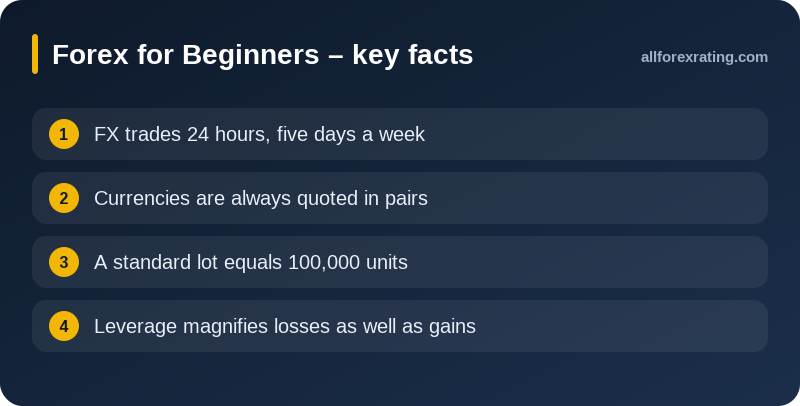
The foreign exchange market is where currencies are swapped against each other. Banks, companies, funds and individual traders all take part, and trading runs around the clock from Monday morning in Asia to Friday evening in New York. Prices always come in pairs, such as EUR/USD, because buying one currency means selling another at the same moment.
For a retail trader the market is reached through a broker, usually via a platform such as MetaTrader. You do not own the euros or dollars you trade; in most cases you hold a contract for difference (CFD) or a spot position that moves with the exchange rate.
| Term | What it means | Why it matters |
|---|---|---|
| Pip | The standard smallest price step, usually the fourth decimal (second for yen pairs) | Profits, losses and spreads are measured in pips |
| Spread | The gap between the bid and ask price | It is a cost you pay on every trade |
| Lot | The trade size; a standard lot is 100,000 units of the base currency | Lot size decides how much each pip is worth |
| Leverage | Borrowed exposure, for example 1:30 | It magnifies gains and losses equally |
| Stop-loss | An order that closes a losing trade at a set price | It caps how much one trade can cost you |
You do not need to read every post at once. Work through the category in roughly this order and come back as questions appear:
Once these feel familiar, move on to our structured education articles and, later, the trading strategy posts.
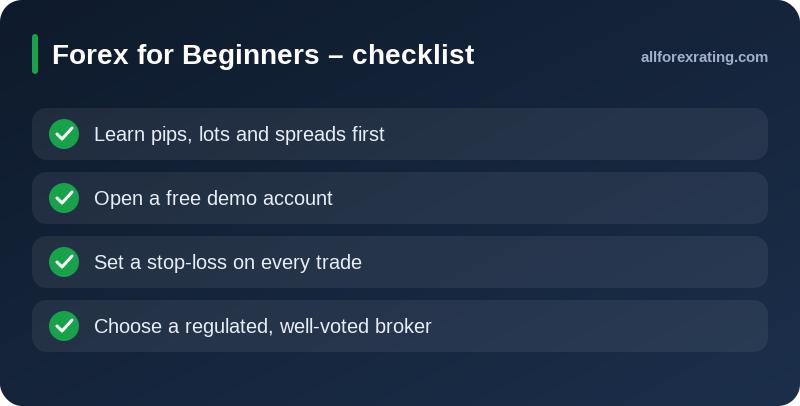
A beginner's broker should be regulated by a recognised authority, offer a free demo account, publish its spreads and fees clearly and let you start with small position sizes such as micro lots. You can check whether a firm is authorised on regulator registers, for example the Financial Conduct Authority in the UK.
On our site, broker rankings come from real traders voting For or Against, not from paid placements. The best forex brokers list is a sensible starting shortlist, and the broker comparison tool lets you put two or three candidates side by side before you open anything.
Most of these errors share one root cause: risking too much on a single idea. A common guideline is to risk only a small, fixed fraction of the account on each trade, so that a run of losses is uncomfortable rather than ruinous.
Read one article, then try the idea on a demo account the same week. Note what you did and why in a journal. This simple loop of learn, test and review turns theory into skill far faster than reading alone. If a term is unclear, search the category above, as most basics are covered in a dedicated post.
Keep in mind that forex and CFD trading with leverage carries a high risk of losing money quickly. Treat the material in forex for beginners as education, never as a promise of profit, and only trade with money you can afford to lose.
Many brokers accept small first deposits and offer micro lots, so you can start with a modest amount. It is wiser to practise on a demo account first and only deposit money you can afford to lose.
The basics, such as pairs, pips and order types, can be learned in a few weeks. Trading consistently well takes much longer and requires discipline, risk control and a tested plan.
Major pairs such as EUR/USD or USD/JPY are popular with newcomers because they usually have tight spreads and plenty of liquidity. Avoid exotic pairs until you understand their wider costs.
A demo account is ideal for learning platforms and testing ideas without risk. Live trading adds emotions and real execution, so many traders move to a small live account after consistent demo results.