, 10 min read
$50 No Deposit Forex Bonus 2027 Top 6 Best Brokers
$50 no deposit bonus is promotional trading credit a broker adds to a new live account after sign-up, usually after phone or ID checks. You...
Read article$50 no deposit bonus is promotional trading credit a broker adds to a new live account after sign-up, usually after phone or ID checks. You...
Read articleCompare forex broker ratings from leading independent review sites side by side. See the top-rated brokers for 2027 — IG, Pepperstone, FP Ma...
Read articleKCM Trade AI Mentor vs Human Analysts gives beginners a clear comparison of feedback, guidance, and learning speed before they choose a path...
Read articleSolus Finance brings trading contests to life with a gamified platform for competition, strategy, and real-time performance tracking.
Read articleCompare Forex brokers in 2027 with a wider lens, from spreads and commissions to regulation, trading tools, order quality, and client servic...
Read articleGFunded Prop Firm Review with a clear look at rules, funding options, fees, payouts, and support, plus who it fits and who should skip.
Read articleSee which of the 7 best regulated forex brokers for 2027 offer strong oversight, fair pricing, and secure tools for active day and swing tra...
Read articleCommon promotions include a matched welcome bonus, where the broker adds funds equal to your deposit. For instance, deposit $100, trade with...
Read articleSee the Best Copy Forex Trading Platforms for 2027, ranked by cost, tools, and safety. Compare signals, copy pros, and pick a broker you can...
Read articleFind forex brokers with 5 no-deposit bonuses in 2027, top picks only. We rate rules, withdrawal limits, and support, so you can try with no...
Read articleJoin RoboForex and claim your $30 welcome bonus. Experience quick access to global markets and open your first trades with zero deposit.
Read articleMaxifyFX offers a $35 sign-up no deposit Forex bonus for new users. Trade with bonus funds and discover platform features without risking yo...
Read articleJustMarkets now offers new app users a $10 free promotion, making it easy to start trading without any deposit. After signing up, you'll get...
Read articleLearn how forex deposit bonuses can give your trading account a real edge. Simple tips help you use every bonus to its fullest potential.
Read articleGrab a $50 FenzoFx No Deposit Bonus today. Sign up in minutes and test the platform risk-free. Get started with extra funds on your account.
Read articleGet honest insights into KCM Trade broker's features, fees, and reliability. Understand if it’s the right platform for your investment goals...
Read articleStart trading with Grand Capital $500 No Deposit Bonus. Trade without risk and explore real market opportunities. Sign up and claim your bon...
Read articleVonway is offering an 85% Forex trading bonus for Eid Al-Fitr, available for a limited time. This promotion is designed to enhance your trad...
Read articleClaim your free $30 no deposit bonus from Vonway Forex today. Start trading risk-free and unlock new opportunities in the forex market!
Read articleStarting with a $50 bonus on an XM trading account can be a great way to test the waters of forex trading without risking your own money.
Read articleThe forex analysis posts in this category explain why currency pairs are moving and where key decision points lie. Each article combines the fundamental picture, such as interest rates, inflation and growth, with technical structure on the charts, giving you a fuller view than either approach alone.
Currencies are priced in pairs, so every move reflects the relative strength of two economies. Understanding both sides of that comparison is the foundation of every piece published here.
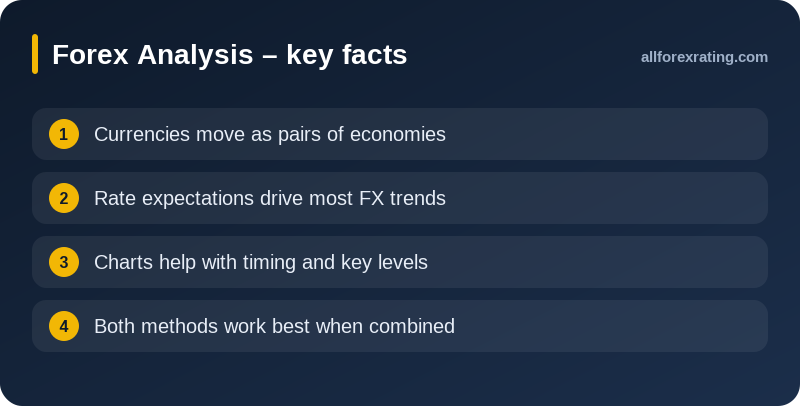
Fundamental work asks what a currency should be worth given its economy and policy outlook. The biggest driver is usually the expected path of interest rates. When markets expect one central bank to keep rates higher for longer than another, capital tends to flow towards the higher-yielding currency. Inflation reports, employment data, GDP figures and trade balances all feed into those expectations. Research from bodies like the Bank for International Settlements also offers useful background on global currency markets.
Technical work studies price itself: trend direction, support and resistance, momentum and chart patterns. It helps answer when and where to act, even when the fundamental story is already known. Our dedicated technical analysis category goes deeper into specific chart tools.
| Aspect | Fundamental | Technical |
|---|---|---|
| Main question | Why should price move? | When and where might it move? |
| Key inputs | Rates, inflation, growth, policy | Price, trend, levels, momentum |
| Typical horizon | Weeks to months | Minutes to weeks |
| Main limitation | Timing can be vague | Can ignore the bigger picture |
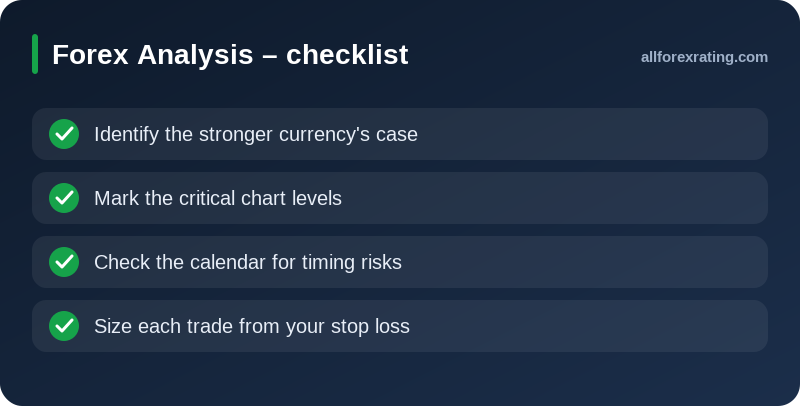
Imagine the fundamental picture favours the US dollar because inflation data has pushed rate expectations higher, while euro area growth looks soft. That suggests a bias towards a lower EUR/USD. The technical side then asks where to act: perhaps price is rallying back towards a former support zone that may now act as resistance. A trader could wait for signs of rejection there, place a stop above the zone and aim for the most recent low. If an upcoming release surprises in the opposite direction, the plan is cancelled. This is the kind of reasoning each forex analysis post walks through.
These posts sit between quick daily recaps and longer term outlooks. If you need specific scenarios with targets, the forex forecasts section is more focused. If you prefer ready-made alerts, the forex signals category explains how signals work and their limitations. The articles here are best for traders who want to understand the reasoning and make their own decisions. Over time, following that reasoning closely helps you build the habit of forming independent views instead of relying on someone else's calls.
Applying any idea well also depends on your broker. Traders who react to fundamental news often need reliable execution during volatile periods, so comparing firms in our best forex brokers ranking, based on real traders' votes, is a sensible step.
Forex analysis improves the quality of your decisions but cannot remove uncertainty. Leveraged currency and CFD trading can produce fast losses, and even carefully reasoned views are often wrong. Treat every article as education, risk only a small share of your capital per trade and keep a journal to learn from both wins and losses.
Fundamental analysis looks at economic data and policy to explain why a currency should move. Technical analysis studies price charts to judge when and where it might move.
Central bank rate decisions, inflation reports and employment figures usually have the largest impact, because they shape interest rate expectations.
It depends on the horizon. A view based on chart levels may change within days, while a fundamental outlook can hold for weeks unless new data shifts expectations.
No. Use the analysis as input for your own plan, and only trade setups that fit your strategy, timeframe and risk limits.