
Gemini trading volume – last 30 days
The volume chart appears after the next data update.
Live data from CoinGecko, updated 3 minutes ago.
Gemini began trading on Nasdaq under the ticker GEMI in September 2025, adding public-company disclosure to a business that was already one of the most tightly supervised in crypto. This Gemini review is written for buyers, particularly in the United States, who put compliance and security ahead of the lowest possible fee.
A Trust Company, Not Just an Exchange
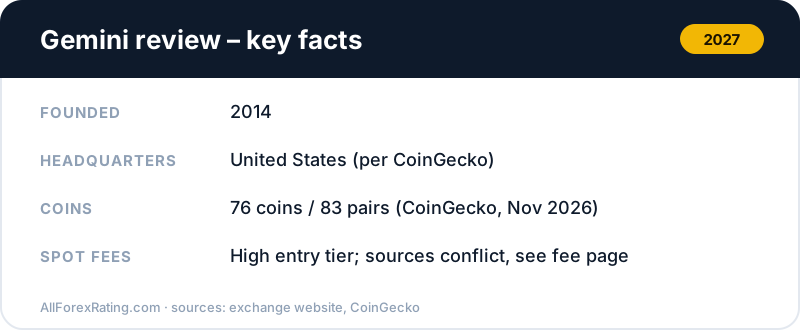
Gemini was founded in 2014 by the Winklevoss twins and is based in the United States, according to CoinGecko. Its core licence is a New York trust charter from the New York Department of Financial Services. A trust company carries more obligations than a typical exchange registration.
The firm has since expanded abroad. In August 2025 it received a MiCA licence through Malta's MFSA, which supports its growth across the European Union.
Put together, the regulatory profile looks like this:
- NYDFS trust charter in New York
- MiCA crypto-asset service provider licence in the EU
- Nasdaq listing since September 2025
Security First
Security is the reason most users pick Gemini. CoinGecko records no security incidents for the exchange. Several other large exchanges in our research have suffered breaches over the years, so a clean history is a meaningful point in its favour.
Its status as a trust company also matters here. Supervision by the NYDFS brings standards on custody and controls that a lightly regulated offshore exchange does not have to meet.
A clean record is not a guarantee. Use two-factor authentication and consider self-custody for long-term holdings, as you would anywhere.
Gemini Review of Fees: The Main Drawback
Cost is where Gemini loses ground. The official ActiveTrader schedule shows high fees at the lowest tier, well above what many exchanges charge new users. CoinGecko lists a much lower range, so the published figures conflict.
What is clear is that small accounts pay the most. If you plan to trade often in modest amounts, compare Gemini's current schedule with alternatives before committing. Check the official fee page for your tier.
What You Can Trade
CoinGecko lists 76 coins and 83 pairs on Gemini as of November 2026. That covers the major assets, but altcoin traders will find the menu short.
Products include:
- Spot trading and the ActiveTrader interface
- Staking
- A Gemini credit card
- Derivatives for non-US users, depending on region
There is no margin trading. US customers do not have access to the derivatives offering.
Who Gemini Is For
Gemini is a sensible choice for US buyers who want a regulated home for Bitcoin, Ether and other large assets. EU users who value a licensed, publicly listed provider may also find it attractive now that the MiCA licence is in place.
Active traders chasing low costs or a wide coin list are the users most likely to be disappointed. A trader making frequent small orders could see fees add up faster here than on cheaper venues.
Opening an Account
Sign up on the official Gemini website and complete identity verification. Once approved, link a funding method, enable two-factor authentication and decide whether the standard interface or ActiveTrader suits your trading style.
Bottom Line
Gemini offers one of the strongest regulatory and security profiles in our research: a New York trust charter, an EU licence, a stock-market listing and no recorded incidents. You pay for that through high entry-tier fees and a small selection of coins.
If peace of mind matters more to you than cost, Gemini is worth a close look. If price is your priority, it probably is not the right fit.
How Gemini compares
Before you sign up, compare Gemini with the other exchanges in our top 20 crypto exchanges ranking, where trust score and 24-hour volume update live. Two useful comparisons are the Bitstamp by Robinhood review and the BingX review. You can also follow prices on our live crypto charts. Fees, licences and coin lists change often, so check the current terms on the official site at gemini.com before you deposit.
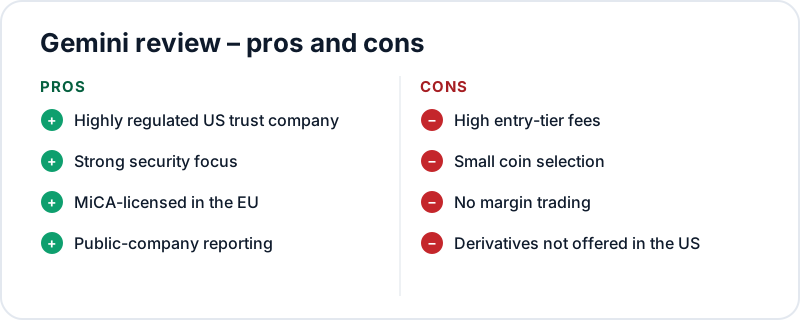
Pros
- Highly regulated US trust company
- Strong security focus
- MiCA-licensed in the EU
- Public-company reporting
Cons
- High entry-tier fees
- Small coin selection
- No margin trading
- Derivatives not offered in the US
Crypto market indicators today
Bitcoin price with SMA 20 / SMA 50 (60 days)
RSI 14 (Relative Strength Index)
Crypto Fear & Greed Index
Last 30 days. 0–24 extreme fear, 25–44 fear, 45–55 neutral, 56–75 greed, 76–100 extreme greed. Source: alternative.me
Indicators are calculated from CoinGecko daily closing prices. They describe the market and are not trading advice.
Gemini – frequently asked questions
Is Gemini a regulated exchange?
Yes. Gemini holds a New York trust charter from the NYDFS and a MiCA licence from Malta's MFSA, granted in August 2025.
Is Gemini a public company?
Yes. Gemini has been listed on Nasdaq under the ticker GEMI since September 2025.
Are Gemini fees high?
Gemini's official ActiveTrader schedule shows high fees at the lowest tier, while CoinGecko lists a lower range. Check the official fee page before trading.
Who founded Gemini?
Gemini was founded in 2014 by the Winklevoss twins.